Utilizing Music for Memory Care can be remarkably effective and powerful because of music’s fascinating ability to reach us in ways that words alone cannot. For those with Alzheimer’s & dementia, conversation can become more difficult. However, the brain often continues to recognize familiar rhythms, emotions, memories, and melodies of familiar songs. Let’s learn more about how music affects the brain, and why it can be such a successful tool in Memory Care.
The Brain: Speech vs. Music
Speech
Several areas of the brain are responsible for speech and conversation. Two of these include the Broca’s area, located in the left frontal lobe, and the Wernicke’s area, found in the left temporal lobe. The Broca’s area helps us to form speech, and the Wernicke’s area helps us understand language. When a person has Alzheimer’s or a related dementia, neurons in the language network connecting these two areas, as well as additional neuron networks, deteriorate as the disease progresses. This commonly occurs earlier in the disease’s progress, and is why people struggle to recall words, or they say phrases they didn’t intend.
Music
Music activates multiple additional areas of the brain, including the Amygdala, the Motor Cortex, Cerebellum, the Hippocampus and the Right Auditory Cortex. These areas are responsible for emotion, movement, rhythm, memory, and pitch/melody recognition respectively. Music engages these sensory pathways that remain active even when language processing becomes more difficult. Even if some of these areas are affected by Alzheimer’s progression, many of the other areas remain fairly protected. In fact, people with Alzheimer’s or a related dementia may participate in singing full lyrics or sharing memories related to the song.
Music Linked to Life
Especially between the ages of 10-30, people become attached to certain pieces of music. During these years, people grow rapidly in ability and comprehension. We form self-identity, and experience transformative life events. Songs that were often heard in college, at one’s wedding, a child’s birth, or when a loved one passed away leave an emotional impact. These memories are often strongly encoded in the brain because they occur during formative life moments. It is often this strong connection between memories and music that allows music to stir our emotions so immediately.
Rhythm & Movement
The predictable rhythms of music activate the Motor Cortex and the Cerebellum of the brain, even when a person is sitting still. This is because the Cerebellum plays an important role as one of the brain’s prediction and timing tools. Music is often perfectly and predictably timed with drums and melodies that can be easily recognized. When the brain is satisfied in this way, the body begins to naturally synchronize with the external stimulus. This is why clapping or tapping to a beat comes instinctively; even infants show signs of this before they can talk. Such instinctive movement can be a great way to help those with Alzheimer’s and dementia stay involved in activities with peers and encourage gentle movement.
Music Connects
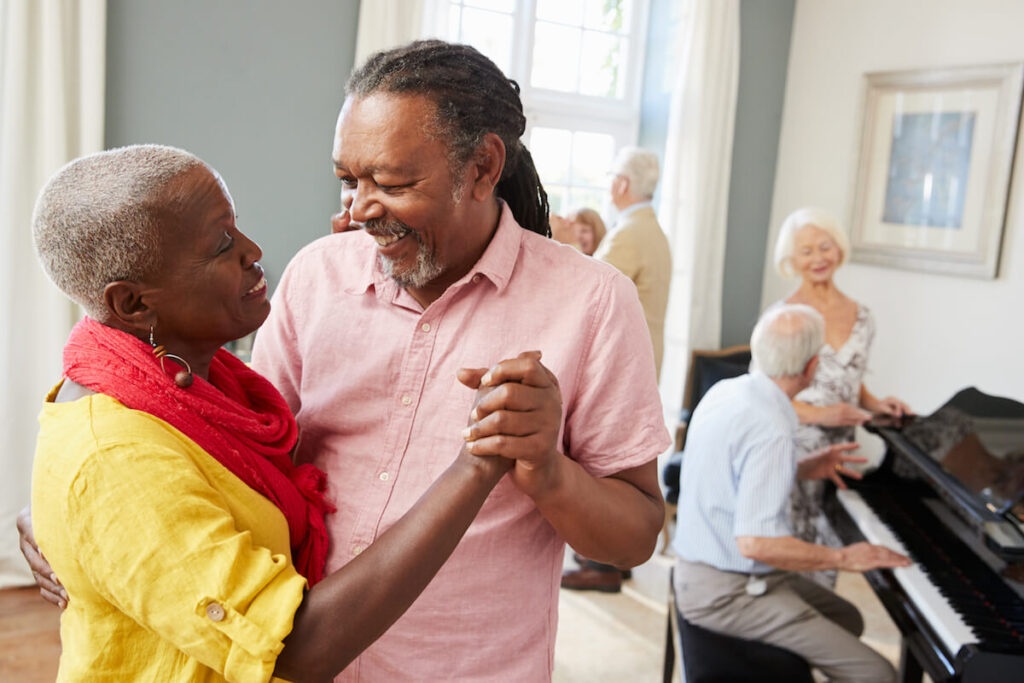
When Alzheimer’s or related dementias progress, connecting with your loved one can be difficult. Music can help bridge some of these communication gaps and allow you to share meaningful moments with your loved one. Music may spark recognition, emotion, and joy. Singing along to a song, gently dancing, or sharing memories related to a song can lead to encouraging connection. Even when speech is limited, a person may respond by tapping their foot, smiling, or softly humming along.
Ideas to Implement
Using music to connect with those living with Alzheimer’s and related dementias can be extremely beneficial. Music can generally improve their mood and help family members connect with them meaningfully. We encourage you to create space in your days to include some tunes!
- Personalized playlist – tailor music to each resident’s life experiences, favorite artists, or meaningful genres
- Morning playlist – Use the personalized playlist every morning to enjoy the routine of getting ready for the day
- During Activities – Utilize music during group activities to encourage the light movement of swaying or tapping.
- Live Music – attend a live music event to encourage the brain to recognize new rhythms
- Sing Together – attend a holiday caroling event or church to encourage singing recognizable songs
Music at Peaceful Pines
By stimulating multiple regions of the brain responsible for emotion, memory, movement, and rhythm, music can reach residents in ways that conversation alone often cannot. Even as Alzheimer’s and dementia affects language and memory, familiar songs can evoke recognition, encourage participation, and create meaningful shared experiences. Thoughtfully integrating music into daily life through playlists, group activities, or live performances can provide a practical, evidence-informed tool to enhance quality of life for both residents and their families. Learn more about our Memory Care lifestyles here: www.peacefulpines.net/memory-care/